- What is MELTS? What is pMELTS? Should I use MELTS or pMELTS?
- How can I use MELTS or pMELTS?
- How can I find out the thermodynamic properties of phases that MELTS and pMELTS knows about?
- What experimental database is MELTS and pMELTS based upon?
- What are the plans for extending MELTS and pMELTS to higher pressures and temperatures?
- What references must I cite when I publish results based upon MELTS or pMELTS?
What is MELTS? What is pMELTS? Should I use MELTS or pMELTS?
MELTS is a software package designed to facilitate thermodynamic modeling of phase equilibria in magmatic systems. It provides the ability to compute equilibrium phase relations for igneous systems over the temperature range 500-2000 °C and the pressure range 0-2 GPa.
Evolution scenarios for magmatic processes can be modeled with MELTS as a series of steps in temperature and pressure (Gibbs energy minimization), temperature and volume (Helmholtz energy minimization), enthalpy and pressure (entropy maximization) or entropy and pressure (enthalpy minimization). Isenthalpic (constant enthalpy), isentropic (constant entropy) or isochoric (constant volume) scenarios can be utilized to explore magmatic processes such as energy constrained assimilation, adiabatic decompression melting, or post-entrapment crystallization in phenocryst melt inclusions. Optionally, equilibrium can be computed in systems open to oxygen transfer at fixed chemical potential (fugacity) of oxygen. This allows both equilibrium and fractional crystallization of magmas to be modeled along a specified oxygen buffer. Water is included as a component in the liquid phase and as a separate pure phase; solubility relations can be modeled as a function of temperature pressure and liquid composition, and the effect of water on phase equilibria is included in the model.
The thermodynamic model for the liquid phase included in the MELTS package was fitted largely from low-pressure experimental phase equilibria and an independent set of thermodynamic data/models for mineral phases. MELTS is intended for modeling magmatic phase relations at low pressure (< 2 GPa). It is better calibrated in mafic systems and should work especially well for MORBS and alkalic mafic magmas. Phase equilibria involving hornblende and biotite are not modeled well by the MELTS package. and consequently simulating the evolution of intermediate to silica-rich calc-alkaline systems is not recommended.
MELTS is based upon the work of Ghiorso and Sack (1995) and Asimow and Ghiorso (1998).
pMELTS is a revised calibration of the liquid thermodynamic model in MELTS and is optimized for mantle bulk compositions. pMELTS is calibrated from an extended experimental database that includes more extensive data at elevated pressure. pMELTS is optimized for "mantle-like" bulk compositions at near solidus conditions (0-30% melting) and is intended to be applied over the temperature range 1000-2500°C and the pressure interval 1-3 GPa. Much above this pressure the model will fail because of limitations inherent with the liquid equation of state. The use of pMELTS at pressures below 1 GPa is not recommended, and great caution should be exercised in applying pMELTS to intermediate or silicic bulk compositions.
The modeling capabilities of the pMELTS software package are identical to those of MELTS.
pMELTS is based upon the work of Ghiorso, Hirschmann, Reiners and Kress (2002).
How can I use MELTS or pMELTS?
There are three ways to use the MELTS (or pMELTS) software package:
- Standalone: If you have access to a Unix-based computer (e.g. a system running Linux or Mac OS X), download a standalone version of the code that generates results on your own computer system. Go to the Unix version or Mac OS X version link if that is what you want to do.
- Web applet: If you do not want to download your own version of MELTS/pMELTS or do not have access to a computer running a Unix-based operating system, then one of the web-based client-server versions of the software might be suitable. The only requirement to run this software is an internet connection and a browser that supports Java 2 applets. This is the only way to run MELTS if you are working on a computer system that runs the Windows operating system. There are two versions of web-applet MELTS/pMELTS. The first may be found at the link Web applet at this web site. A newer MELTS/pMELTS applet is being developed as part of a related project and may be accessed at the CT server web site. We recommend the second applet. The interface has been redesigned to function more like the standalone versions of MELTS. The applet has better client-server communication that will function through firewalls. And, the server has been completely redesigned t enhance stability and throughput.
- Batch: Thanks to Paul Asimow and Paula Smith of CalTech , a scripted-, batch-version of MELTS/pMELTS is available that runs on Windows-based as well Unix-based (Linux Max OS X) systems. Go to theBatch version link for more information.
Choose MELTS Help for access to the manual and example files for standalone MELTS/pMELTS. A manual for the web applet is accessible from the user interface.
How can I find out the thermodynamic properties of phases that MELTS and pMELTS knows about?
Thermodynamic properties of phases included in the MELTS package can be computed using two software products available at this site. The first is a forms-based cgi calculator that may be found at the Calculator (forms) link. The second is a web applet available at the link Calculator (applet). An alternate implementation of this applet is available at the CT server site; go to the link CORBA Phase prop.
What experimental database is MELTS and pMELTS based upon?
The experimental database used to calibrate the liquid thermodynamic model in MELTS is a subset of the larger database utilized in the calibration of pMELTS. The pMELTS database may be interrogated at the Database link on this site.
What are the plans for extending MELTS and pMELTS to higher pressures and temperatures?
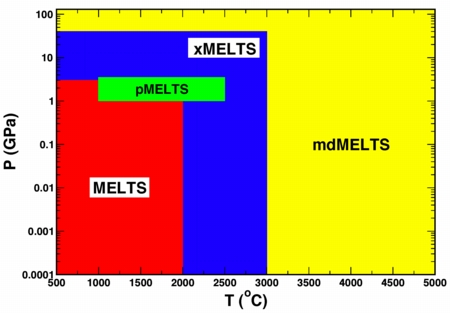
The following figure illustrates future plans for extending MELTS and pMELTS to a broader range of temperature and pressure conditions.

xMELTS is the code name for a currently funded NSF project involving Ghiorso (at OFM Research Inc.), Marc Hirschmann (at the University of Minnesota) and Tim Grove (at M.I.T). The aim is to create an entirely new liquid model that incorporates recently completed work on the liquid equation of state (American Journal of Science, v 304, no 8-9, 2004) and an associated solution formalism that together should facilitate modeling liquid properties from 0.0001 to 40 GPa and 500° to 3000°C. The intended use of xMELTS is as a replacement for MELTS and pMELTS that will extend modeling capabilities to the top of the Earth's lower mantle. One aspect of the xMELTS project is the generation of a comprehensive, up-to-date database of liquid-solid experimental phase equilibrium data. This database will be released independently of the xMELTS model and will be made available at this web site.
The mdMELTS project is a far reaching vision of extending MELTS modeling capabilities down to the base of the Earth's lower mantle. While the"x" in xMELTS stands for extreme, the "md" in mdMELTS stands for molecular dynamics (MD). This project is being undertaken by Ghiorso (at OFM Research Inc.) and Frank Spera (at UC Santa Barbara) and is as yet unfunded. The idea is to extend the silicate liquid equation of state calibration to very high pressure (and temperature) utilizing MD computer simulations of liquids. This will allow liquid-solid phase equilibria to be modeled at high pressure. Our preliminary work on this project is focusing on the system MgO-SiO2. As results and models become available, they will be posted to this web site.
What references must I cite when I publish results based upon MELTS or pMELTS
Unlike Athena, MELTS and pMELTS did not suddenly emerge - fully formed - from the forehead of Zeus. When you use results from MELTS or pMELTS in a publication, abstract or talk, please cite the appropriate reference(s).
Calculations derived from MELTS should be cited as:
Ghiorso, Mark S., and Sack, Richard O. (1995) Chemical Mass Transfer in Magmatic Processes. IV. A Revised and Internally Consistent Thermodynamic Model for the Interpolation and Extrapolation of Liquid-Solid Equilibria in Magmatic Systems at Elevated Temperatures and Pressures. Contributions to Mineralogy and Petrology, 119, 197-212
Asimow PD, Ghiorso MS (1998) Algorithmic Modifications Extending MELTS to Calculate Subsolidus Phase Relations. American Mineralogist 83, 1127-1131
Calculations derived from pMELTS should be cited as:
Ghiorso, Mark S., Hirschmann, Marc M., Reiners, Peter W., and Kress, Victor C. III (2002) The pMELTS: An revision of MELTS aimed at improving calculation of phase relations and major element partitioning involved in partial melting of the mantle at pressures up to 3 GPa. Geochemistry, Geophysics, Geosystems 3(5), 10.1029/2001GC000217